
Industrial Manufacturing
Cooling Could Be Bottlenecking Your Production
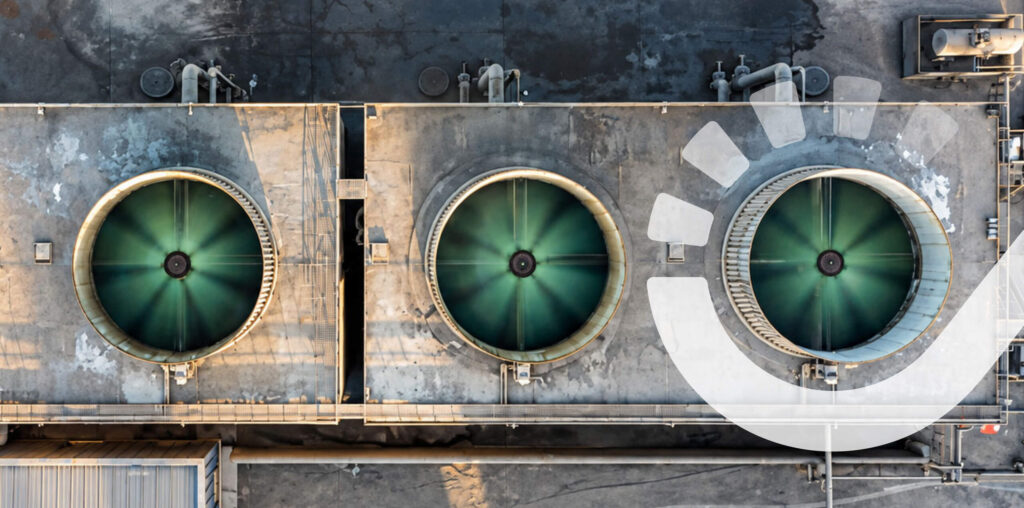
Cooling tower degradation is gradual and nearly invisible. It shows up across the plant: lost output in the in warm weather, drifting process temperatures, unexplained water use, repeat motor failures. Running is not the same as performing.
The Problem
How Much Cooling Are Your Towers Delivering Today?
Your team knows these towers. Nothing on the tower measures its performance. Your towers cool the equipment that sets your rate, and how much that matters depends on the process:
- Compressor inlets. In an ethylene plant, cooling water serves the cracked-gas compressor and refrigeration condensers. Colder water lowers compressor inlet temperature and raises capacity, roughly 0.3% more throughput per degree.¹
- Refrigeration condensers. In food and beverage plants, cooling water removes heat from refrigeration and chiller condensers. When that water runs warmer, condensing pressure rises, so compressors draw more power and deliver less cooling just when production lines need it most.
- Process condensers and exchangers. In refining, colder water on FCC overhead condensers eases wet-gas compressor limits and allows a higher feed rate, about 0.5% more production per 2°C recovered.¹
It happens continuously. Fill fouls, nozzles clog, fan control drifts, one cell loses airflow. None of it announces itself. What the weather changes is only how much it costs you that day — which is why the first clear signal arrives at the worst time: every summer the line slows, and the cause is hard to pin down. Everything the tower feeds is closely instrumented. The tower has only the basics.

Your Instruments Answer Two Questions. Performance Isn’t One of Them.
Read Our White Paper
Neither alarms nor controls were built to manage performance across a twenty-year life. From the control room, a degraded tower looks like a performing one. That’s why the loss goes unnoticed.

Alarms
Is it about to break?

Controls
Is it running the way I set it?

Performance
Is it delivering what it was designed to deliver, and if not, why?
This is the question most cooling towers aren’t equipped to answer.
The Solution
TowerPulse Is the Equipment Health and Operational Intelligence Layer for Industrial Cooling.
It retrofits on any cooling system, models your plant’s specific configuration, computes what each cell should deliver under current conditions, explains the gap, ranks fixes by impact, and confirms the fix worked.
- Sense. Wireless surface-mount and ultrasonic sensors on existing ports to capture what existing instrumentation doesn’t. No redesign, no shutdown.
- Validate. A data integrity layer turns noisy field measurements into decisions.
- Model. Physics-informed heat and mass transfer, cell by cell, normalized for weather, load and fan control. Trained on [100,000+] hours of real operating data.
- Score. Overall and subsystem scores, tower and cell, every five minutes.
- Act. Ranked opportunities quantified in production, energy, water and maintenance cost, simulated before you commit.
Two things matter to your engineers: it needs no season of baseline data, and every conclusion traces to a mechanism they can inspect and challenge. Average installation in under a week, without interrupting operations — at a 300+ kt/yr alumina refinery, the plant’s own team installed it. Alerts by email, text and push. No seat limits.
What Continuous Equipment Health Gives You
You Report Numbers, Not a Schedule
Where the towers stand. What’s recoverable. What it’s worth. When you’ll have it. Capital planning runs on measured condition: whether the replacement already in the five-year plan is necessary, necessary sooner, or not at all. Water and energy figures become measured and auditable instead of estimated. Across sites, scores roll up so corporate sees which plants are constrained and where the next capital dollar earns most.
Your Crew Works on What Matters
Which cell, which component, what it takes and what it’s worth — before anyone opens anything. Each finding comes with the action it calls for. Many are operational adjustments or routine maintenance your crew can complete while the plant runs, and they start returning right away. Larger repairs are scoped to the specific cell and component, so you plan targeted work instead of a tower-wide teardown.
You See Where You Stand
A score for the tower and every cell, broken out by fill, fan, pumps and water distribution, normalized for ambient conditions and load. Every five minutes. A loss shows up the week it starts. You can identify degradation in winter, before you need your cooling most.
Now Imagine You Can See It
Not a temperature readout. How much cooling each cell is capable of right now, against what it should deliver under today’s weather and load — and when it falls short, why, and what it’s costing.
You Prove the Work Landed
The model re-baselines after the repair. Every intervention carries a before-and-after number — which is how maintenance spend stops being a cost you defend and becomes capacity you bought.
Everything Today’s Approaches Can’t See
What It Costs You, Week to Week
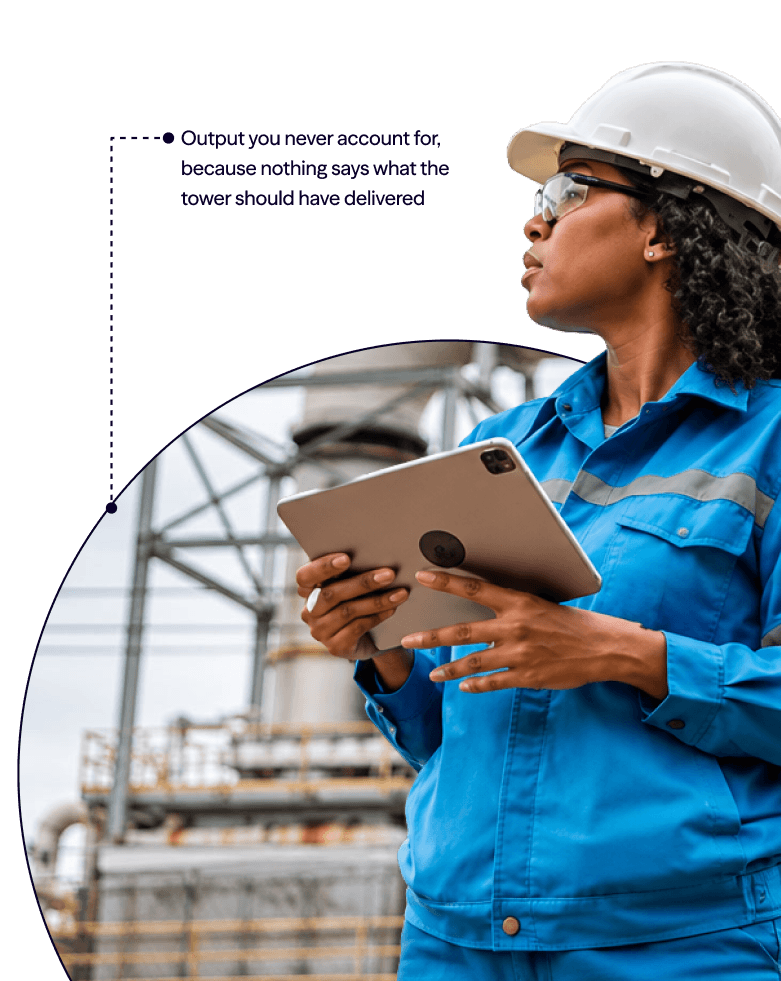
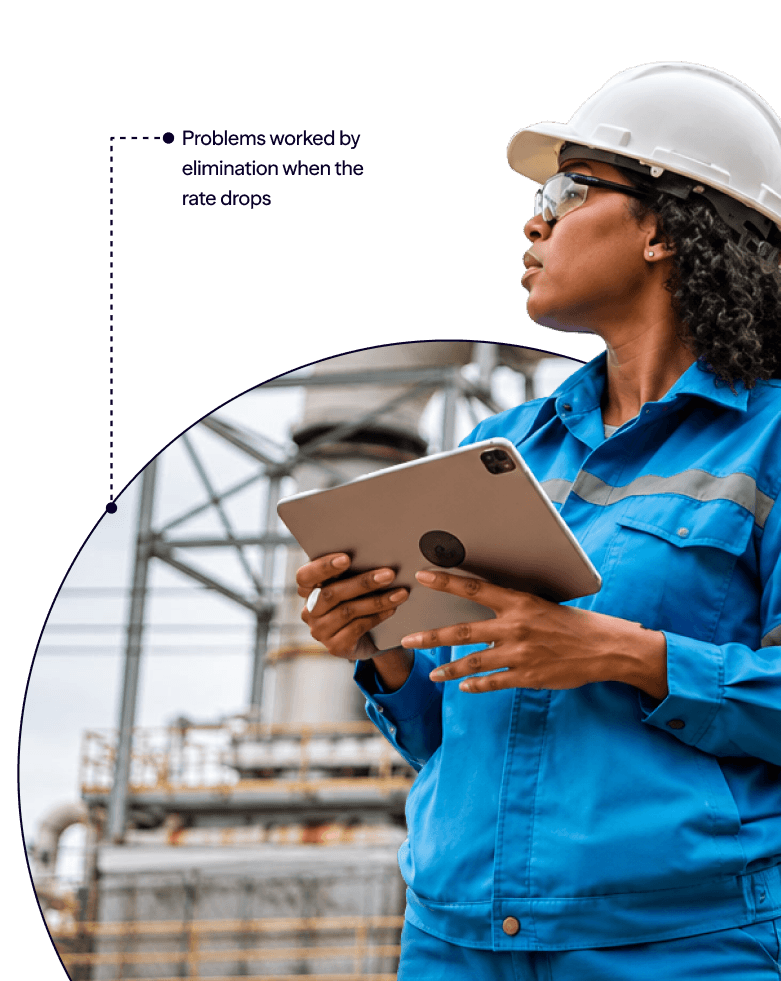
Output you never account for, because nothing says what the tower should have delivered. Problems worked by elimination when the rate drops. No baseline when asked why water use jumped.
And it compounds. Degradation runs whether or not anything looks wrong, and every hot stretch bills you for everything accumulated since the last one.
Proof
At One Bottling Plant, Savings Started Quickly and Kept Coming
The plant routinely curtailed output in the heat. TowerPulse’s first finding came in month two, and more followed.
-
A fan control scheme exceeding cycling limits: the hidden cause of years of motor failures.
-
Severe fill clogging, localized by cell. A $500k tower replacement avoided.
-
A water leak, found by modeling evaporation against actual makeup.
-
A fan the controls showed as running was idle. 39 kW; constraint relieved.
-
Cell-specific airflow score caught early motor slippage. Caught before failure; 20 kW.
$165k/yr Operating Savings. $500k Capital Avoided. Payback Under Six Months.
The value didn’t stop at payback: five findings in just over a year, each with its own return.
Towerpulse Makes Your Team and Partners More Effective
Compressors, chillers and condensers are precision machines sold on an efficiency curve, so they ship with performance monitoring. A tower is a large passive structure — air, water, fill, fans — specified once at design and assumed to hold for decades.
Instrumentation cheap and non-intrusive enough to retrofit onto a running tower; physics modeled finely enough to say what a specific cell should deliver under today’s conditions; and enough real operating hours to train that model and keep it honest.
Infinite Cooling came out of an MIT lab studying how water and air move through cooling towers, then spent years deploying inside operating plants.
Manufacturers build and service the equipment, and where intelligence is being added it ships embedded in new towers — which doesn’t reach a mixed-brand installed base, where your production dollars and capital decisions live. Controls vendors tune how the tower runs, which isn’t measurement of capability. Your water treatment provider is at the tower more than anyone, and their programs are advanced — on chemistry. Different jobs, each done well.
From one of the world’s largest food and beverage companies to MIT’s own campus. Funded by Material Impact, the U.S. Department of Energy and the National Science Foundation. Advised by Mark Little, former CTO of GE; Carmichael Roberts, Material Impact; Phil Cooper, Pine Island; Jeff McCarthy, North Bridge Ventures. Founded [2019], headquartered in [Malden], Massachusetts.
Calculate Your Savings
Share one tower’s operating conditions from last summer. We’ll estimate recoverable capacity, energy, and water. No install, no commitment.